
Abstract. Generative AI now does much of the reading, researching and explaining that developers once had to do themselves. That effort was also a form of practice. This essay argues, as a hypothesis rather than a finding, that deliberate long-form reading may help counter the cognitive offloading that heavy AI use encourages. It draws on two recent studies of AI use and critical thinking, both correlational, and on no direct evidence yet that reading protects against these effects.
I have started thinking that people who vibe code should probably read more books. The reason is a bit mechanical. I suspect we are quietly losing a specific kind of cognitive stamina, and long-form reading might be the most accessible way to get it back.
Think about what learning a new technology or solving a difficult programming problem looked like just a few years ago. You had to read. You read API references, GitHub issues, lengthy blog posts, Stack Overflow threads, and source code. It was often incredibly boring. Nobody genuinely loved parsing through poorly formatted AWS documentation to figure out IAM permissions. But you had to do it, because there was no conversational model sitting next to you capable of explaining the exact context of your problem. That friction was annoying, but it also served a hidden purpose. It forced us to practice reading difficult material, holding context in our heads, comparing conflicting information, and building our own mental models of how a system worked.
Vibe coding changes this workflow entirely. Now, the friction is gone. You can look at a failing build and simply ask the model why it is failing. You can paste a link to a dense technical manual and tell the model to extract the important parts. You can ask for the TL;DR, and the model does the reading, the interpretation, and the explanation for you. This is undeniably useful. I am not arguing that people should stop using AI or go back to manually reading every piece of documentation, as I use these tools constantly to clear away the tedious parts of my day. The thing I am interested in is the habit that may disappear when the friction disappears.
How AI changes the developer's cognitive workload
- Reading Documentation
- Manual Debugging
- Building Mental Models
- Prompting and Output Review
If you spend years relying on AI to explain everything, summarize everything, and extract the important parts, you naturally become less comfortable with reading something long, difficult, or boring. This is a matter of reading stamina, cognitive endurance, patience with complexity, and the willingness to construct your own understanding rather than immediately receiving someone else’s compressed explanation.
1. A tutor, or a replacement
There is a massive difference between reading a 300-page book and then asking an AI to help clarify the author’s argument, versus never reading the book and asking the AI for a 500-word summary. From the outside, those two scenarios look very similar because in both cases you can walk away and hold a conversation about the core concepts. But they are fundamentally different experiences. If I read the book and use the AI to discuss it, the AI is acting as a tutor, helping me engage with material I have already wrestled with. If I skip the book entirely and consume the summary, I have received information, but I have completely bypassed the experience of understanding the work. The issue is not whether AI is used, but whether AI is helping me understand something I have engaged with, or replacing the engagement entirely.
Two ways of learning the same material
Read first, then ask
- Read the source material
- Ask AI to clarify
- Build your own mental model
Skip the reading
- Skip the source material
- Ask AI for a summary
- Illusion of knowledge Fails on edge cases
The exact same distinction applies to software development. An LLM can give you a beautiful, highly structured explanation of distributed systems, database indexing, or system architecture. You read it and think that it makes perfect sense. But understanding an explanation in the moment is not the same thing as possessing the mental model behind it. The real test always comes later. Can you explain the trade-offs yourself when the model is not there to reconstruct the reasoning for you? Can you recognize when the AI’s recommendation does not actually fit your system, or tell when the generated architecture is subtly wrong? Can you reason about an edge case the model entirely failed to mention? That is where intellectual ownership matters. You have to understand the system well enough to reason about it independently, and that depth is rarely built by consuming a thirty-second summary.
2. Cognitive offloading
Researchers use the term cognitive offloading[3] to describe how humans outsource mental work to external tools. Writing a list or using a calculator are forms of cognitive offloading we have accepted for a long time. Generative AI, however, vastly expands the amount and the type of cognitive work that can be outsourced. We are no longer just offloading memory or arithmetic; we are offloading reading, synthesis, and basic reasoning.
A 2025 study published in Acta Psychologica[1] looked specifically at the relationship between AI dependence, cognitive fatigue, and critical thinking. The researchers found an association between heavy reliance on AI tools and lower reported levels of critical thinking effort, particularly noting that when people are tired or facing complex tasks, they naturally lean more heavily on AI for answers. This often correlates with accepting outputs with less scrutiny. It is important to be intellectually honest about what this research actually establishes. The findings are correlational, meaning it is entirely possible that people who are already fatigued rely on AI more, rather than the AI causing the fatigue or degrading their innate critical thinking skills. But the research gives us a very clear reason to take the possibility of cognitive offloading seriously.
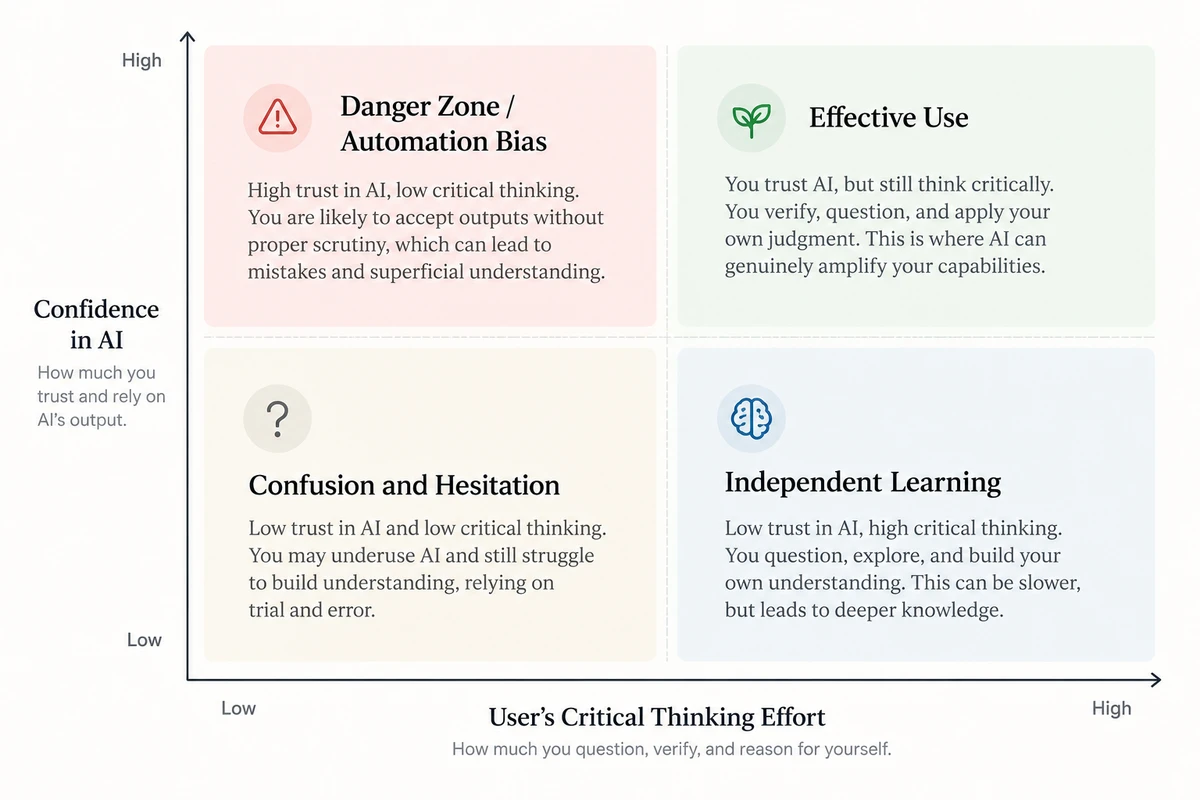
This aligns with work from Microsoft Research on generative AI and critical thinking[2], which noted a dynamic where greater confidence in an AI system is associated with less reported critical-thinking effort from the user. When the machine sounds highly confident and produces plausible answers, we simply do not check its work as rigorously. We stop building our own mental model of the problem because the AI has already handed us one that looks good enough to compile.
3. Friction as resistance training
This brings us back to vibe coding and the loss of friction. Coding became significantly easier, but some of the activities surrounding coding also became easier: reading, researching, debugging, comparing competing solutions, and interpreting unfamiliar documentation. Because AI removes the need to struggle through that difficult technical material, developers are getting significantly less practice doing sustained reading. That annoying work was secretly serving as resistance training for our attention spans. When you spent two hours reading source code to understand why a library was failing, you were practicing cognitive endurance.
4. Why books
If it is true that AI is removing our daily practice of sustained engagement with complex material, then deliberately reading books becomes a very interesting proposition. Books are one of the simplest ways to maintain that cognitive habit. I want to treat this strictly as a hypothesis. I have not found a longitudinal study proving that people who read more books are protected from the cognitive effects of AI overreliance. Instead, we have research on cognitive offloading and AI overreliance on one side, and separate research on deep reading, sustained attention, and cognition on the other. What I am proposing is a connection between those two areas. Could maintaining a strong long-form reading habit act as a counterweight to excessive cognitive offloading from AI?
I think the answer might be yes, simply because reading a book keeps you practicing the act of engaging with something that cannot be compressed into a convenient answer every thirty seconds. A novel can take 300 pages to resolve. A serious non-fiction book might spend an entire chapter just building the foundation for an argument. When you read a book, you have to remember something from fifty pages ago to understand what is happening right now. You have to sit through sections that are not immediately useful. You have to tolerate ambiguity. You have to figure out what the author means instead of pinging a model to clarify it for you. You are forced to construct the mental model yourself.
That habit is going to become increasingly valuable in an AI-heavy world. We are rapidly moving toward a future where we rarely have to read anything difficult if we do not want to, because the models will always be there to digest the complexity and feed us the results.
If AI keeps getting better at reading, summarising, explaining and coding for us, what happens to the human habit of doing those things ourselves? And perhaps the more interesting question: if reading is one of the ways we practice thinking, should we deliberately keep doing more of it precisely because AI makes it so easy to stop?
5. Limitations
This is an essay, not a study. Both papers it leans on are correlational, so they cannot show that AI use causes lower critical-thinking effort. I have not found direct evidence that reading books protects against cognitive offloading, which is why the argument is framed as a hypothesis. The proportions in Figure 1 are a conceptual illustration, not measured data.
References
- Tian, J., & Zhang, R. (2025). Learners’ AI dependence and critical thinking: The psychological mechanism of fatigue and the social buffering role of AI literacy. Acta Psychologica. ScienceDirect
- Lee, H.-P., Sarkar, A., Tankelevitch, L., Drosos, I., Rintel, S., Banks, R., & Wilson, N. (2025). The impact of generative AI on critical thinking: Self-reported reductions in cognitive effort and confidence effects from a survey of knowledge workers. Proceedings of the 2025 CHI Conference on Human Factors in Computing Systems (CHI ‘25), Article 1121, 1–22. doi:10.1145/3706598.3713778
- Risko, E. F., & Gilbert, S. J. (2016). Cognitive offloading. Trends in Cognitive Sciences, 20(9), 676–688. doi:10.1016/j.tics.2016.07.002